Reshoring Playbook for Canadian Manufacturers
Reshoring isn’t a trend. It’s a correction.
For three decades, Canadian manufacturers moved production offshore chasing unit price. China. Vietnam. India. The math looked obvious. $4/part versus $11/part. Case closed. Ship it overseas.
Then came a pandemic. Then came container costs that tripled overnight. Then came a U.S. president imposing 25% tariffs on Canadian goods while forcing companies to rethink every border their supply chain crosses. The math that justified offshoring in 2005 doesn’t hold up in 2026.
Canada’s manufacturing sector has shed tens of thousands of jobs. The sector’s share of GDP dropped from 18% in the early 2000s to roughly 10% today. Over 80% of our manufactured exports go to one customer: the United States. And that customer just changed the rules.
This isn’t an article about whether reshoring makes sense. It’s a playbook for how to do it. Step by step. With real numbers, real programs, and a shortcut most manufacturers haven’t considered.
What This Guide Covers
This is a working document for manufacturing executives, operations leaders, supply chain directors, and business owners evaluating how to bring production back to Canada.
Here’s what’s inside:
- Why reshoring is accelerating and why the window to act is now
- The real cost of offshore manufacturing with a total landed cost breakdown that exposes the true price gap
- Canada’s reshoring advantages that most companies undervalue
- A six-step reshoring decision framework you can apply this quarter
- Government funding programs that offset 35-40% of reshoring costs
- The digital inventory shortcut that lets you reshore without building a factory
- Industry-specific considerations for defence, aerospace, automotive, and consumer goods
- Common mistakes that derail reshoring projects
Bookmark this page. You’ll come back to it.
Why Reshoring Is Accelerating in Canada
Four forces are converging to make reshoring urgent.
1. Tariffs changed the math overnight
In 2025, the United States imposed 25% tariffs on Canadian goods, with targeted duties on steel, aluminum, and automotive components. The impact was immediate.
A CME survey found that 75% of Canadian manufacturers are experiencing moderate to severe impacts from U.S. tariffs, including reduced investment and employment. More than 90% face some level of disruption. Economists estimate the tariff cycle has already reduced Canadian GDP by 1.5 to 2%.
Here’s the part most executives miss: these tariffs aren’t a Canada-U.S. problem alone. They’re forcing every company to re-examine where they source and where they produce. Companies already offshore are paying tariffs on top of tariffs. Companies that produce in Canada for the Canadian market are discovering domestic sourcing is a competitive advantage, not a cost penalty.
2. Supply chain disruption became permanent
COVID didn’t create supply chain fragility. It exposed it.
Companies that relied on single-source offshore suppliers watched lead times stretch from 6 weeks to 6 months. Container shipping costs went from $2,000 to over $15,000. Parts stuck in ports. Production lines idle. Revenue evaporating while finished goods sat on a ship in the Pacific.
The disruptions haven’t stopped. Red Sea shipping reroutes, port strikes, geopolitical tensions, extreme weather. The assumption that you can reliably source from 10,000 km away at predictable cost and timing is no longer valid. Canadian businesses are already cutting import delays with local production.
3. Government policy is pulling production home
Ottawa is putting real money behind reshoring. The Buy Canadian Policy, implemented December 2025, requires federal procurements valued at $25 million or more to prioritize Canadian suppliers. By June 2026, that threshold drops to $5 million. Canadian suppliers receive a 10% price preference in evaluation.
This isn’t symbolic. The federal government spends billions annually on procurement across defence, infrastructure, healthcare, IT, and industrial goods. Companies that produce in Canada will have a structural bidding advantage. Companies that don’t will lose contracts.
Add NGen’s $87.5 million in advanced manufacturing funding. The new $244 million Defence Industry Assist program through NRC IRAP. Enhanced SR&ED credits providing up to $2.1 million per year in refundable cash back. The federal government is stacking incentives to make reshoring financially attractive.
4. Canadian consumers and businesses want domestic products
Buy Canadian sentiment isn’t a hashtag. It’s a purchasing shift. Surveys consistently show Canadian consumers will pay a premium for domestically produced goods when they can identify them. B2B buyers are increasingly requiring Canadian content in their supply chains for compliance, risk reduction, and ESG reporting.
The combination of all four forces creates a window. Companies that reshore now capture government funding, Buy Canadian procurement advantages, supply chain resilience, and consumer preference. Companies that wait will compete for the same advantages with everyone else who finally gets the memo.
The Real Cost of Offshore Manufacturing
Here’s where most reshoring conversations go wrong: they compare unit price to unit price. Your offshore supplier quotes $4/part. Your Canadian supplier quotes $11/part. The math looks like a no-brainer. Stay offshore.
But unit price is not total cost. Not even close.
The total landed cost breakdown
Total landed cost captures every expense from the moment a purchase order is issued until the finished part is sitting on your shelf, ready to ship. Here’s what most companies leave out.
Unit price (the visible cost): $4.00/part
Now add what’s hiding behind it:
| Hidden Cost Category | Typical % Added | On a $4 Part |
|---|---|---|
| Ocean freight + inland shipping | 5-12% | $0.20 - $0.48 |
| Customs duties + brokerage fees | 3-8% | $0.12 - $0.32 |
| U.S./Canada tariffs (current) | 10-25% | $0.40 - $1.00 |
| Quality inspection + rework | 3-8% | $0.12 - $0.32 |
| Inventory carrying cost (6-month lead time) | 12-18% | $0.48 - $0.72 |
| Currency fluctuation risk | 2-5% | $0.08 - $0.20 |
| IP risk and tooling protection | 1-3% | $0.04 - $0.12 |
| Travel for supplier audits | 1-2% | $0.04 - $0.08 |
| Expedite fees (rush orders) | 3-10% | $0.12 - $0.40 |
| Obsolescence write-offs (MOQ overstock) | 5-15% | $0.20 - $0.60 |
| Total hidden costs | 45-106% | $1.80 - $4.24 |
True landed cost of that $4 part: $5.80 to $8.24.
Your Canadian supplier at $11 doesn’t look so expensive anymore. Especially when you factor in 2-day delivery, no MOQ requirements, design iteration speed, and zero IP risk. For a deeper look at how carrying costs destroy your margins, run the numbers on your own inventory.
This isn’t theoretical. Studies consistently show offshore sourcing adds an average of 27% in hidden costs. With current tariffs, that number is closer to 40-60% for many product categories.
The costs nobody puts in the spreadsheet
Beyond those line items, there are systemic costs that erode your business over time:
Time to market. Offshore lead times of 8-16 weeks mean you’re designing products half a year before customers see them. Your competitor with domestic production is iterating in real time.
Engineering overhead. Managing offshore suppliers requires dedicated staff for communication across time zones, quality systems, logistics coordination, and compliance documentation. That’s a full-time salary or two that doesn’t appear in your per-part cost comparison.
Opportunity cost. Working capital locked in 6-month inventory pipelines is capital not deployed in R&D, marketing, or new product development. At a 10-12% cost of capital, $1 million in pipeline inventory costs you $100,000-$120,000 per year in foregone returns.
Customer relationships. When a quality issue surfaces or demand spikes, your offshore supplier is 12 time zones away. Your domestic partner picks up the phone. Responsiveness isn’t a line item. But lost customers because of delayed deliveries absolutely show up on your P&L.
Run the real comparison
Before reading further, run this exercise for your own product line:
- Take your top 10 offshore-sourced parts by volume
- Calculate total landed cost using the categories above
- Get quotes from Canadian manufacturers for the same parts
- Compare total landed cost to total landed cost. Not unit price to unit price.
If you’re like most companies that do this exercise honestly, at least 30-40% of your offshore parts are already more expensive on a total cost basis. And that’s before government funding offsets are applied.
Canada’s Reshoring Advantages
Canada has structural advantages that make it a stronger reshoring destination than most executives realize.
Skilled workforce with manufacturing DNA
Canada has over 1.7 million people employed in manufacturing and related industries. Cities like Hamilton, Kitchener-Waterloo, Winnipeg, Montreal, and Edmonton have deep manufacturing talent pools going back generations. Polytechnics and trade schools produce thousands of CNC operators, welders, tool and die makers, and industrial engineers every year.
The talent is here. It’s experienced. And unlike competing labour markets, Canadian manufacturers aren’t bidding against Big Tech for every skilled worker.
Proximity to the U.S. market
Over 80% of Canadian manufactured goods are exported to the United States. Same-day or next-day trucking to major U.S. markets. Detroit, Chicago, New York, and Seattle are all within a day’s drive of Canadian production hubs.
For companies that sell into the U.S., producing in Canada means shorter logistics chains, lower shipping costs, fewer borders, and faster response times compared to Asian supply chains.
Energy cost advantage
Canada has some of the lowest industrial electricity rates in the developed world, particularly in hydro-rich provinces. Quebec’s industrial rate sits around 7.8 cents/kWh. Manitoba and British Columbia are similarly competitive.
Compare that to 12-18 cents/kWh in much of the U.S. and 15-25 cents/kWh in Europe. For aluminum smelting, steel processing, plastics manufacturing, and other power-hungry operations, Canadian energy costs offset labour differentials.
Clean energy grid
Quebec, Manitoba, and British Columbia generate over 85% of their electricity from hydroelectric sources. For companies with ESG commitments, carbon reporting requirements, or customers who care about supply chain emissions, producing on Canada’s clean grid is a competitive differentiator.
Honda’s decision to locate a new battery plant in Canada explicitly cited clean power and low-emissions manufacturing capability. This trend will accelerate as carbon border adjustments become standard in global trade.
Government support infrastructure
No other G7 country matches Canada’s combination of direct funding programs, tax credits, and procurement preferences for domestic manufacturing. NGen, IRAP, SR&ED, ACOA, FedDev Ontario, PrairiesCan, PacifiCan, CanExport, and IDEaS all provide direct financial support for companies that manufacture in Canada.
The Reshoring Decision Framework: Six Steps
Reshoring isn’t a single decision. It’s a sequence of assessments, calculations, and pilots.
Step 1: Map Your Supply Chain Vulnerabilities
Before you decide what to reshore, understand where your current supply chain is exposed.
Create a risk map. For every component, subassembly, and raw material in your product line, document:
- Supplier location. Country, region, specific facility.
- Number of qualified suppliers. Single source? Dual source? Many?
- Lead time. Average and worst-case over the last 24 months.
- Delivery reliability. What percentage of orders arrived on time and in full?
- Quality performance. Rejection rates, rework frequency, warranty claims.
- Tariff exposure. Current and potential duties on this part or material.
- IP sensitivity. Does this part contain proprietary designs or processes?
- Revenue impact if disrupted. What happens to your production line if this part is 8 weeks late?
Prioritize by risk. Not every component needs to be reshored. Focus on parts that meet two or more of these criteria:
- Single-source from a high-risk region
- Lead time over 8 weeks
- Tariff-exposed at 10% or higher
- Quality rejection rate above 3%
- High IP sensitivity
- Revenue impact above $100K per week if disrupted
This exercise takes 2-4 weeks for a mid-sized manufacturer. It’s the foundation of every reshoring decision that follows. Don’t skip it.
Step 2: Calculate True Total Landed Cost
Take the parts you flagged in Step 1 and run a full total landed cost analysis. Not the quick version. The real version.
Use the cost categories from the breakdown above. Be honest about hidden costs. Most companies underestimate them by 40-60% because the costs are spread across different departments and budget lines.
Build a comparison model. For each flagged part, calculate:
- Current total landed cost (offshore, including all hidden costs)
- Estimated Canadian total landed cost (domestic quotes + local logistics)
- Cost gap (positive or negative)
- Potential funding offsets (SR&ED, NGen, IRAP credits applied to Canadian production)
- Net adjusted cost gap after funding
For many parts, the net adjusted cost gap will be smaller than expected. For some, Canadian production will already be cheaper. For others, the gap exists but is narrow enough that resilience, speed, and quality improvements justify the premium.
Step 3: Identify Reshoring Candidates
Based on Steps 1 and 2, sort your parts into three buckets:
Reshore now. Total cost parity or advantage. High supply chain risk. Strong strategic rationale. These move first.
Reshore within 12 months. Small cost premium (under 15%) offset by risk reduction and funding. Need to qualify new suppliers or validate processes. These go into the pilot pipeline.
Keep offshore for now. Large cost gap. Low risk. Commodity parts with multiple qualified global sources. Revisit annually as tariffs, shipping costs, and funding programs evolve.
Most companies find that 20-40% of their offshore parts fall into the first two buckets. That’s a significant chunk of supply chain risk you can eliminate without destroying your cost structure.
Step 4: Find Canadian Manufacturing Partners
This is where most reshoring efforts stall. You know what you want to reshore. You know the math works. But you don’t know who can make it in Canada.
Options for finding partners:
- The Assembly’s network. We connect you with vetted Canadian manufacturers across CNC machining, 3D printing, injection molding, sheet metal, and more. One request, multiple quotes, verified quality. Explore our producer network.
- NGen’s cluster network. NGen connects manufacturers with advanced technology partners across Canada. Their Cluster Accelerator Program specifically supports this matchmaking.
- CME (Canadian Manufacturers & Exporters). The largest trade association for manufacturers in Canada. Their member directory is a starting point.
- Canada Makes. Canada’s additive manufacturing network, connecting companies with 3D printing and advanced manufacturing capabilities.
- Regional development agencies. FedDev Ontario, ACOA, PrairiesCan, and PacifiCan all maintain directories and relationship networks for manufacturers in their regions.
What to evaluate in a Canadian partner:
- ISO certifications relevant to your industry (9001, 13485, AS9100, IATF 16949)
- Production capacity and current utilization
- Material sourcing and supply chain for raw inputs
- Quality systems and inspection capabilities
- Prototype and small-batch capabilities (critical for pilot phase)
- Scalability path from pilot to full production
- Geographic proximity to your facility or customers
Don’t try to find a single partner for everything. Reshoring works best as a distributed strategy: different partners for different capabilities, coordinated through a network.
Step 5: Run a Pilot Program
Never reshore at full volume on day one. Pilot first, then scale.
Structure your pilot:
- Select 3-5 parts from your “reshore now” list
- Produce a small batch (50-200 units) with your Canadian partner
- Validate dimensional accuracy, material properties, and surface finish against offshore benchmarks
- Compare actual total cost to your modeled estimates
- Test delivery reliability over 2-3 order cycles
- Document quality and communication advantages
- Calculate time savings from shorter lead times
Timeline: A well-structured pilot takes 8-12 weeks from first contact to validated results.
Success criteria (define these upfront):
- Part quality meets or exceeds offshore baseline
- Total landed cost within 15% of offshore (or better)
- Lead time reduction of 50% or more
- Delivery on-time rate above 95%
If the pilot hits these marks, you have your business case for scaling. If it doesn’t, you’ve learned something valuable at minimal cost.
Step 6: Scale and Optimize
Once pilots validate, scale methodically.
Transition plan:
- Move reshored parts to Canadian production in waves, not all at once
- Maintain offshore backup supply for 90 days during transition
- Build safety stock during overlap period
- Negotiate volume pricing with Canadian partners as quantities increase
- Apply for government funding (NGen, IRAP, SR&ED) to offset transition costs
- Monitor cost, quality, and delivery metrics weekly during transition
Continuous improvement:
- Review total landed cost quarterly
- Evaluate additional reshoring candidates every 6 months
- Use design-for-manufacturing feedback from Canadian partners to reduce costs
- Explore digital inventory for low-volume and spare parts to eliminate warehousing costs entirely
Government Funding and Support Programs
Canada offers one of the most generous funding ecosystems for domestic manufacturing in the G7. Here’s what’s available.
NGen (Next Generation Manufacturing Canada)
What it funds: Advanced manufacturing technology projects, AI integration in manufacturing, collaborative R&D.
Current programs:
- Advanced Manufacturing Technology Projects 2025. $87.5 million in funding. Projects between $1.5M and $8M. NGen covers up to 40% of eligible costs. Projects must involve at least two Canadian partners, with one being an SME (under 500 employees). Completion deadline: January 31, 2028.
- AI for Manufacturing Challenge. Up to $13 million for integrating AI/ML into production. Covers up to 40% of project costs.
- Cluster Accelerator Program. Up to $100,000/year for organizations supporting the advanced manufacturing ecosystem.
Best for: Manufacturers investing in new production technology, automation, or digital manufacturing capabilities as part of a reshoring initiative.
Apply at: ngen.ca/funding
NRC IRAP (Industrial Research Assistance Program)
What it funds: R&D projects, technology development, process innovation for Canadian SMEs.
Key details:
- Available to incorporated Canadian SMEs with fewer than 500 employees
- Covers up to 80% of eligible project costs
- Funding ranges from $50,000 to $1 million+
- Budget 2025 allocated an additional $39.9 million for international demonstration of Canadian innovation
New in 2025-2026: Defence Industry Assist (DI Assist). $244.2 million invested through IRAP to help SMEs advance made-in-Canada defence and dual-use technologies. This is a significant new funding source for manufacturers in defence supply chains.
Best for: SMEs developing new manufacturing processes, adapting production for reshored products, or innovating in their manufacturing operations.
Contact: 1-877-994-4727 or visit nrc.canada.ca
SR&ED (Scientific Research and Experimental Development)
What it funds: Tax credits for R&D activities, including manufacturing process development.
Enhanced rates (Budget 2025 updates):
- Enhanced rate for CCPCs: 35% refundable tax credit on first $6 million of qualifying expenditures (up from previous limits)
- Maximum refundable cash back: Up to $2.1 million per year
- Basic rate: 15% for expenditures beyond the enhanced limit
- New: Canadian public corporations now eligible for the enhanced 35% credit
- Reinstated: Capital expenditures (equipment, machinery, apparatus) once again eligible for both SR&ED deductions and investment tax credits for property acquired after December 16, 2024
New administrative improvements (effective April 1, 2026):
- Elective pre-claim approval process for upfront technical validation
- Processing time reduced from 180 to 90 days with pre-approval
Best for: Any manufacturer investing in process innovation, new production methods, or technology development. If you’re adapting manufacturing processes for reshored production, those R&D activities likely qualify.
ACOA (Atlantic Canada Opportunities Agency)
What it funds: Business development, manufacturing scale-up, and export readiness for businesses in Atlantic Canada (New Brunswick, Nova Scotia, Prince Edward Island, Newfoundland and Labrador).
Best for: Manufacturers in Atlantic provinces expanding capacity for reshored production. ACOA prioritizes regional economic development and funds facility expansion, equipment acquisition, and workforce development.
Regional Development Agencies
Each region of Canada has a dedicated development agency:
- FedDev Ontario for Ontario manufacturers
- PrairiesCan for Alberta, Saskatchewan, Manitoba
- PacifiCan for British Columbia
- CED for Quebec (Canada Economic Development for Quebec Regions)
- CanNor for Northern territories
These agencies provide direct funding, loans, and advisory services for manufacturing expansion. If you’re reshoring production to a specific province, start with the regional agency. They know the local landscape and connect you with additional provincial programs.
CanExport
What it funds: Export development activities for Canadian SMEs and industry associations.
Key details:
- CanExport SMEs: Funding for companies pursuing international export opportunities, with new emphasis on defence and dual-use technologies
- CanExport Associations: Up to $500,000/year for industry associations, covering 50% of eligible costs (75% for defence-related)
- CanExport Innovation: Supports R&D collaborations with international partners
Best for: Manufacturers reshoring to serve both domestic and export markets. If your reshoring strategy includes capturing U.S. or global market share, CanExport offsets export development costs.
IDEaS (Innovation for Defence Excellence and Security)
What it funds: Pre-commercial defence and security technologies.
Key details:
- Up to $20 million per project
- Applicants must demonstrate at least 50% Canadian content
- Administered through the Department of National Defence
Best for: Manufacturers in or entering the defence supply chain. With $244 billion in new Canadian defence spending committed, the defence manufacturing opportunity is massive.
How to stack these programs
Smart manufacturers don’t pick one program. They stack multiple programs on the same investment. Here’s an example:
A manufacturer invests $2 million in new CNC equipment and process development to reshore production of defence components.
- SR&ED: Claim the R&D portion of process development. At 35%, that returns $175,000-$350,000.
- IRAP DI Assist: Apply for defence technology development funding. Covers 40-80% of eligible R&D costs.
- NGen: If the project involves advanced manufacturing technology and a collaborative partner, NGen funds 40% of a broader project.
- Buy Canadian preference: Once producing in Canada, gain a 10% pricing advantage on all federal procurement bids over $5 million.
The cumulative offset covers 35-50% of your reshoring investment. That changes the math dramatically.
Important: You cannot claim the same expense under multiple programs. But you can claim different portions of the same project under different programs. Work with a funding consultant or your accountant to structure claims correctly. IRAP-funded costs reduce your SR&ED eligible expenses, for example, but the remaining expenses still qualify.
The Digital Inventory Shortcut
Here’s the part of the reshoring conversation that most guides miss entirely.
When executives think “reshoring,” they picture building a factory. Buying equipment. Hiring operators. Millions in capital expenditure. Years to get up and running.
That’s one way to do it. But for many companies, it’s not the right way.
You don’t need a factory. You need a network.
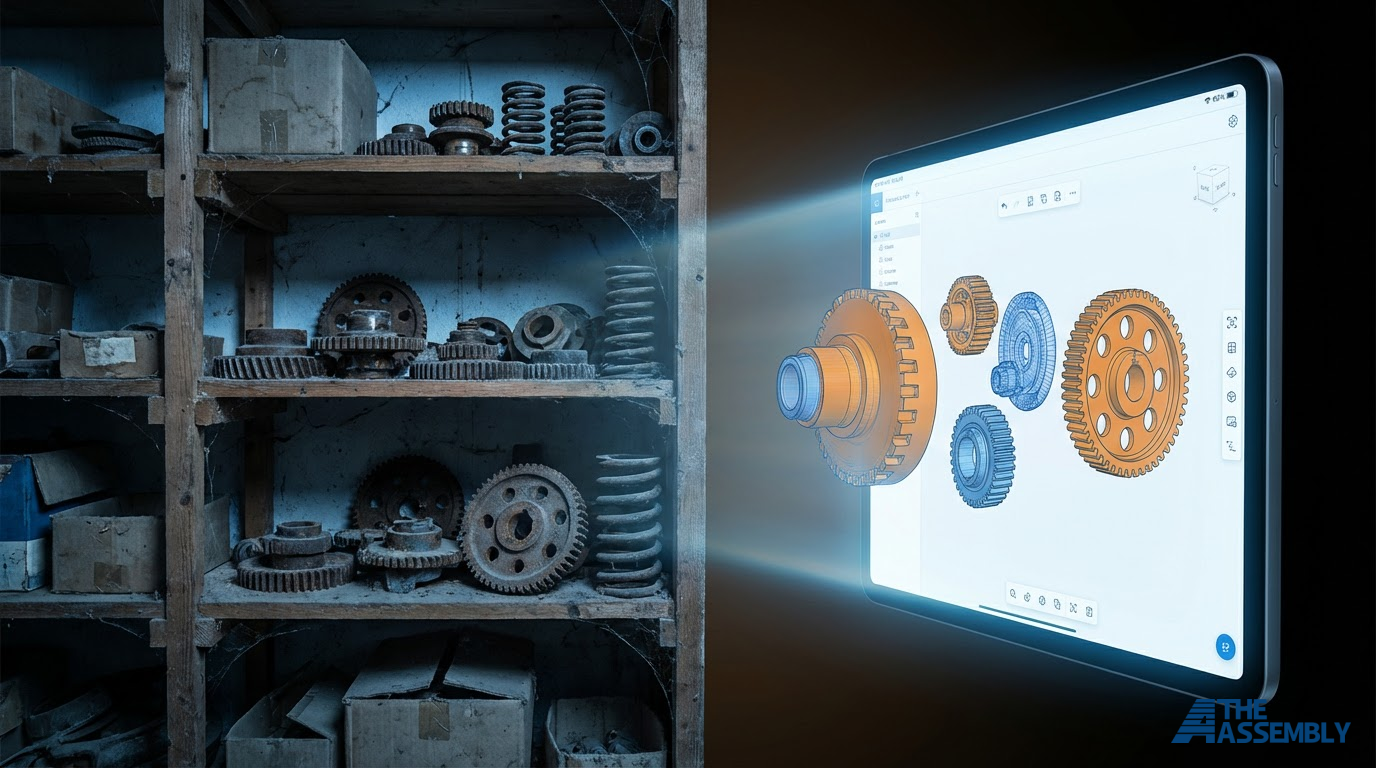
Digital inventory replaces physical stock with production-ready CAD files connected to a distributed manufacturing network. Instead of warehousing thousands of parts, you store the digital designs and produce on demand through qualified Canadian manufacturers.
This fundamentally changes the reshoring equation:
| Traditional Reshoring | Digital Inventory Reshoring |
|---|---|
| Build or buy a factory | Access an existing network |
| $2M-$50M capital investment | Near-zero capital investment |
| 12-24 months to production | Weeks to production |
| Fixed capacity (use it or lose it) | Elastic capacity (scale up or down) |
| One location | Multiple locations across Canada |
| You manage equipment, staff, facilities | Network manages production |
| Minimum volumes to justify investment | Produce 1 part or 10,000 |
For a full breakdown of why this model beats traditional warehousing, read our digital inventory vs. traditional warehousing comparison.
How it works for reshoring
- Upload your parts. Provide CAD files and specifications for the components you want to reshore.
- We match you with Canadian producers. Our network includes CNC machining, 3D printing, injection molding, sheet metal fabrication, and finishing services across the country.
- Validate quality. Run a pilot batch. Confirm the parts meet your specifications.
- Produce on demand. Order what you need, when you need it. No MOQs. No warehousing. No idle equipment.
This approach is particularly powerful for:
- Spare parts and aftermarket. Low-volume, high-variety parts that are expensive to inventory but critical to maintain. Digital inventory eliminates the warehouse entirely.
- New product introduction. Test market fit with small batches before committing to high-volume production.
- Seasonal or variable demand. Scale production up and down without carrying excess inventory.
- Legacy parts. Components for older products that still need support but don’t justify dedicated tooling.
The math
Compare two reshoring scenarios for a company with 200 SKUs currently sourced from China:
Scenario A: Build your own facility
- Capital investment: $5-10M
- Timeline to production: 18 months
- Ongoing overhead: $800K-1.5M/year
- Break-even: 3-5 years
- Risk: High (demand must justify investment)
Scenario B: Digital inventory through a manufacturing network
- Capital investment: Near zero (CAD file preparation costs)
- Timeline to production: 4-8 weeks
- Ongoing cost: Pay per part, per order
- Break-even: Immediate (no fixed overhead to cover)
- Risk: Low (scale up or down based on actual demand)
Scenario B doesn’t make sense for every product. High-volume, low-mix production (making millions of identical parts) still benefits from dedicated facilities. But for the 60-80% of SKUs that are low-to-medium volume, digital inventory through a network is the fastest, cheapest, and lowest-risk path to Canadian-made production.
Book a call to evaluate which of your parts are candidates for network-based reshoring.
Industry-Specific Reshoring Considerations
Reshoring strategy varies by sector. Here’s what to know for four key industries.
Defence and Aerospace
Why it matters: Canada has committed to significantly increased defence spending. The new Buy Canadian procurement policy explicitly covers defence and security procurements. The $244 million DI Assist program through IRAP targets defence SMEs. Controlled goods regulations already require Canadian-based handling for many defence components.
Key considerations:
- ITAR and controlled goods compliance require documented Canadian production chains
- AS9100 and NADCAP certifications are required for aerospace components
- Long qualification cycles (6-18 months) mean starting now for contracts in 2027-2028
- IDEaS program offers up to $20M per project for defence technology
- 50% Canadian content requirement for IDEaS aligns with reshoring objectives
Opportunity: The convergence of increased defence spending, Buy Canadian policy, and DI Assist funding creates the strongest reshoring case of any sector. If you’re in the defence supply chain, reshoring isn’t optional. It’s a prerequisite for the contracts coming in the next 3-5 years.
Automotive
Why it matters: The auto sector has been hit hardest by U.S. tariffs. Canada’s integrated North American auto supply chain means tariffs on components cascade through the entire value chain. CUSMA rules of origin require increasing North American content.
Key considerations:
- IATF 16949 certification required for Tier 1 and Tier 2 suppliers
- PPAP (Production Part Approval Process) takes 6-12 months for new suppliers
- EV and battery manufacturing is a growth area where Canada has strategic advantages (critical minerals, clean grid)
- Honda, Stellantis, and VW have all committed to Canadian EV production facilities
Opportunity: The EV transition is creating entirely new supply chains that don’t yet exist. Reshoring into EV component manufacturing is a greenfield opportunity, not a displacement of existing offshore relationships.
Consumer Goods
Why it matters: Buy Canadian consumer sentiment is at an all-time high. Consumers will pay a premium for Canadian-made products. E-commerce enables direct-to-consumer brands to capture that premium.
Key considerations:
- Faster design iterations with domestic production
- Smaller batch sizes viable through on-demand manufacturing
- “Made in Canada” labelling provides marketing advantage
- Lower MOQs from domestic suppliers reduce inventory risk
- Seasonal demand variability is easier to manage with local production
Opportunity: Consumer goods is the easiest sector to pilot reshoring because batch sizes start small. Use digital inventory to test Canadian production for a single product line before expanding.
Medical Devices and Equipment
Why it matters: COVID exposed Canada’s dependence on foreign-made medical equipment. Government procurement now prioritizes domestic health sector suppliers under the Buy Canadian policy.
Key considerations:
- ISO 13485 certification required for medical device manufacturing
- Health Canada regulatory approval processes for domestically produced devices
- Traceability and documentation requirements are stringent
- Clean room manufacturing required for certain components
- Long product lifecycles create ongoing spare parts requirements (ideal for digital inventory)
Opportunity: The Buy Canadian policy specifically covers health and pharmaceutical procurements. Manufacturers who produce medical devices and components in Canada will have a procurement advantage starting now.
Common Reshoring Mistakes
Most reshoring failures aren’t caused by bad strategy. They’re caused by poor execution. Avoid these.
Mistake 1: Comparing unit price only
We’ve covered this. Total landed cost is the only valid comparison metric. If your reshoring business case is built on unit price comparison, it will collapse under scrutiny from anyone who asks about shipping, tariffs, quality, and carrying costs. Build the full model.
Mistake 2: Trying to reshore everything at once
Reshoring your entire supply chain simultaneously is a recipe for quality issues, missed deadlines, and organizational chaos. Start with your highest-risk, easiest-to-transition parts. Prove the model. Then expand.
Mistake 3: Expecting offshore pricing from domestic suppliers
Canadian manufacturers have higher labour costs and higher regulatory compliance costs. That’s real. But they also deliver faster, iterate quicker, produce at higher quality, and don’t charge you for 16,000 km of ocean freight. Compare total value, not the price on the quote.
Mistake 4: Ignoring government funding
Companies leave millions on the table by not applying for available programs. SR&ED alone returns up to $2.1 million per year. NGen covers 40% of advanced manufacturing project costs. IRAP funds 80% of R&D expenses. If you’re reshoring without tapping these programs, you’re subsidizing the cost gap with your own money.
Mistake 5: Not piloting first
Qualification of a new supplier requires validation. Material testing. Dimensional inspection. Process capability studies. First article inspection. Skip this, and you’ll discover quality issues at production scale when the cost of failure is highest.
Mistake 6: Maintaining only one domestic supplier
The whole point of reshoring is reducing supply chain risk. If you move from one offshore supplier to one domestic supplier, you’ve changed the geography but not the vulnerability. Qualify at least two Canadian sources for critical components. Or use a manufacturing network that provides built-in redundancy.
Mistake 7: Underestimating the transition period
Reshoring takes time. Supplier qualification, first article inspection, ramp-up, and process optimization take 6-12 months per component family. Plan for overlap periods where you’re sourcing from both offshore and domestic suppliers simultaneously. Budget for it.
Reshoring in Action: What It Looks Like
Here’s what a typical reshoring trajectory looks like for a mid-sized Canadian manufacturer.
The scenario
A $15M revenue manufacturer in Ontario produces industrial equipment. They source 120 unique components, 85 from China and Southeast Asia. Average lead time: 12 weeks. Annual spending on offshore components: $3.2 million.
The assessment (Weeks 1-4)
Supply chain mapping reveals:
- 23 components are single-source from China
- 14 components have experienced quality issues requiring rework in the past year
- 31 components are tariff-exposed at 15-25%
- 8 components contain proprietary designs with IP risk
Total landed cost analysis shows the true cost of their offshore components is 34% higher than the quoted unit prices, bringing effective annual spend to $4.3 million.
The shortlist (Week 5)
After running the total landed cost comparison with Canadian quotes:
- 18 components are cheaper to produce domestically (total cost basis)
- 27 components are within 10% cost parity
- 22 components are 10-20% more expensive domestically
- 18 components are 20%+ more expensive domestically
With SR&ED and NGen funding offsets applied, 45 of 85 offshore components are candidates for reshoring at cost parity or better.
The pilot (Weeks 6-18)
Five components selected for pilot production through Canadian manufacturing partners:
- CNC machined housing: Validated in 3 weeks. Quality exceeded offshore baseline.
- Sheet metal bracket: Validated in 2 weeks. Lead time dropped from 14 weeks to 5 days.
- 3D printed prototype fixture: Validated in 1 week. Design iteration that previously took 8 weeks now takes 3 days.
- Injection molded cover: Required tooling investment. NGen funding application submitted for 40% offset.
- Welded assembly: First article passed. Volume pricing within 7% of offshore total landed cost.
The scale (Months 6-18)
Production transitions to Canadian sources in three waves:
- Wave 1 (18 components): Immediate reshoring. Cost-neutral or cost-positive.
- Wave 2 (27 components): Reshored over 6 months as suppliers qualify and funding is secured.
- Wave 3 (remaining components): Evaluated annually. Some remain offshore. Some shift to digital inventory for on-demand production.
The result
After 18 months:
- 45 of 85 components now Canadian-sourced
- Average lead time reduced from 12 weeks to 8 days
- Quality rejections down 60%
- Working capital freed: $400K (reduced pipeline inventory)
- SR&ED credits captured: $180K
- NGen funding secured: $320K
- Net cost impact: 2% total reduction (savings on some parts offset premiums on others)
- Supply chain risk score: reduced by 55%
That’s the reshoring math. Not “it costs more to make it here.” It costs roughly the same, arrives 10x faster, the quality is better, the government helps pay for it, and you sleep better.
Frequently Asked Questions
Is reshoring always more expensive than staying offshore?
No. When you calculate total landed cost (not unit price), many components are already cheaper to produce in Canada. For others, the premium is 5-15%, often offset by government funding, reduced inventory carrying costs, and eliminated shipping expenses. The real question isn’t “is it more expensive?” It’s “what are you actually paying today when you count everything?”
How long does it take to reshore a product line?
Timelines vary by complexity. Simple machined or fabricated parts can be qualified and transitioned in 8-12 weeks. Complex assemblies requiring tooling, certification, or regulatory approval take 6-18 months. Plan for 12 months as a working average. Start now. The companies that started 6 months ago are already capturing the advantages.
What if I can’t find a Canadian supplier for my parts?
Canada’s manufacturing capability is broader than most executives realize. Between CNC machining, additive manufacturing, injection molding, sheet metal, casting, forging, and assembly, most industrial components can be produced domestically. For specialized processes, consider nearshoring to the U.S. or Mexico under CUSMA rather than sourcing from overseas. Manufacturing networks like The Assembly help you search across multiple capabilities simultaneously.
Do I need to build a factory to reshore?
No. This is the biggest misconception about reshoring. On-demand manufacturing networks give you access to Canadian production capacity without capital investment. You don’t need to buy equipment, lease a facility, or hire operators. You need production-ready designs and a qualified network of Canadian manufacturers.
Which government programs should I apply for first?
Start with SR&ED. If you’re investing in any R&D or process development as part of your reshoring effort, SR&ED is the broadest and most accessible program. Then explore IRAP if you’re an SME with a technology-driven project. Then NGen if your project involves advanced manufacturing technology and a collaborative partner. Stack them. Don’t pick one.
How do tariffs affect the reshoring calculation?
Current U.S. tariffs of 10-25% on Canadian goods make the case more nuanced. For companies exporting to the U.S., tariffs add cost whether you produce offshore or in Canada. But for companies serving the Canadian market, tariffs on imported components make domestic sourcing more attractive. And for companies sourcing from China or other tariff-targeted countries, the compounding effect of multiple tariff layers makes reshoring to Canada increasingly competitive. Run the total landed cost calculation for your specific situation.
Can I reshore gradually?
Gradual is better. Start with a pilot of 3-5 parts. Validate quality and cost. Scale to your highest-risk components. Expand over 12-18 months. The six-step framework in this guide is designed for exactly this kind of phased approach. Going all-in on day one is one of the most common reshoring mistakes.
Start Your Reshoring Assessment
You’ve read the playbook. You know the math. You know the programs. The question is whether you’ll act on it.
Every month you wait is another month of inflated total landed costs, supply chain vulnerability, and missed government funding windows. The Buy Canadian procurement threshold drops to $5 million in June 2026. SR&ED enhancements are available now. NGen’s $87.5 million in advanced manufacturing funding is being allocated. These aren’t permanent offers. They’re windows.
Here’s how to start:
- Map your supply chain risk. Use Step 1 from this guide. Identify your most vulnerable components.
- Run the total landed cost analysis. Get honest about what offshore is actually costing you.
- Talk to us. We’ll help you identify which parts can move to Canadian production through our network, without building a factory.
Book a reshoring assessment call. We’ll review your top 10 components, provide Canadian manufacturing quotes, and show you the total cost comparison. No obligation. Math only.
Or run the numbers yourself with our ROI calculator to see how much your current supply chain is actually costing you.
Reshoring isn’t about patriotism. It’s about building a supply chain that works in the world we actually live in. The companies that figure this out in 2026 will have a structural advantage for the next decade.
The playbook is in your hands. Time to run it.