Here’s an uncomfortable truth most supply chain managers won’t tell you: the spare parts sitting in your warehouse are not an asset. They’re a slow-moving liability that eats 20-30% of its own value every year.
Carrying costs. Insurance. Depreciation. Obsolescence. Square footage you’re paying for whether you ship anything or not.
The average Canadian manufacturer has 20-30% of its inventory sitting as dead or obsolete stock. That’s not a rounding error. That’s capital locked on shelves, doing nothing, while your competitors use that same money to invest in growth.
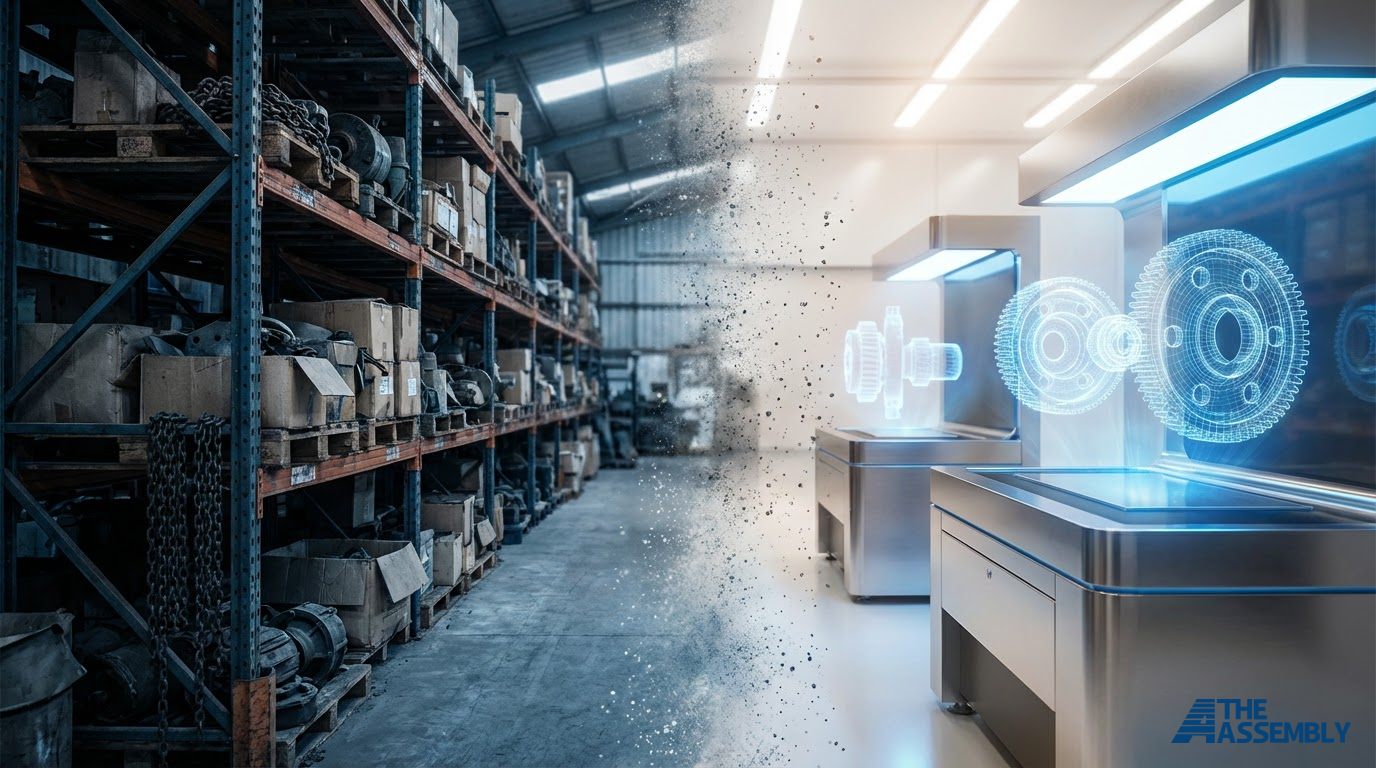
Digital inventory changes this entirely. Not by managing your warehouse better. By eliminating the need for a warehouse at all.
This guide explains what digital inventory is, how it works, why it matters more now than at any point in the last 40 years, and how Canadian manufacturers are using it to cut carrying costs to near-zero while actually improving part availability.
If you’re an operations leader, VP of supply chain, or CFO at a company that stores, ships, or warehouses physical parts, this is the most important shift happening in your industry right now.
What Is Digital Inventory?
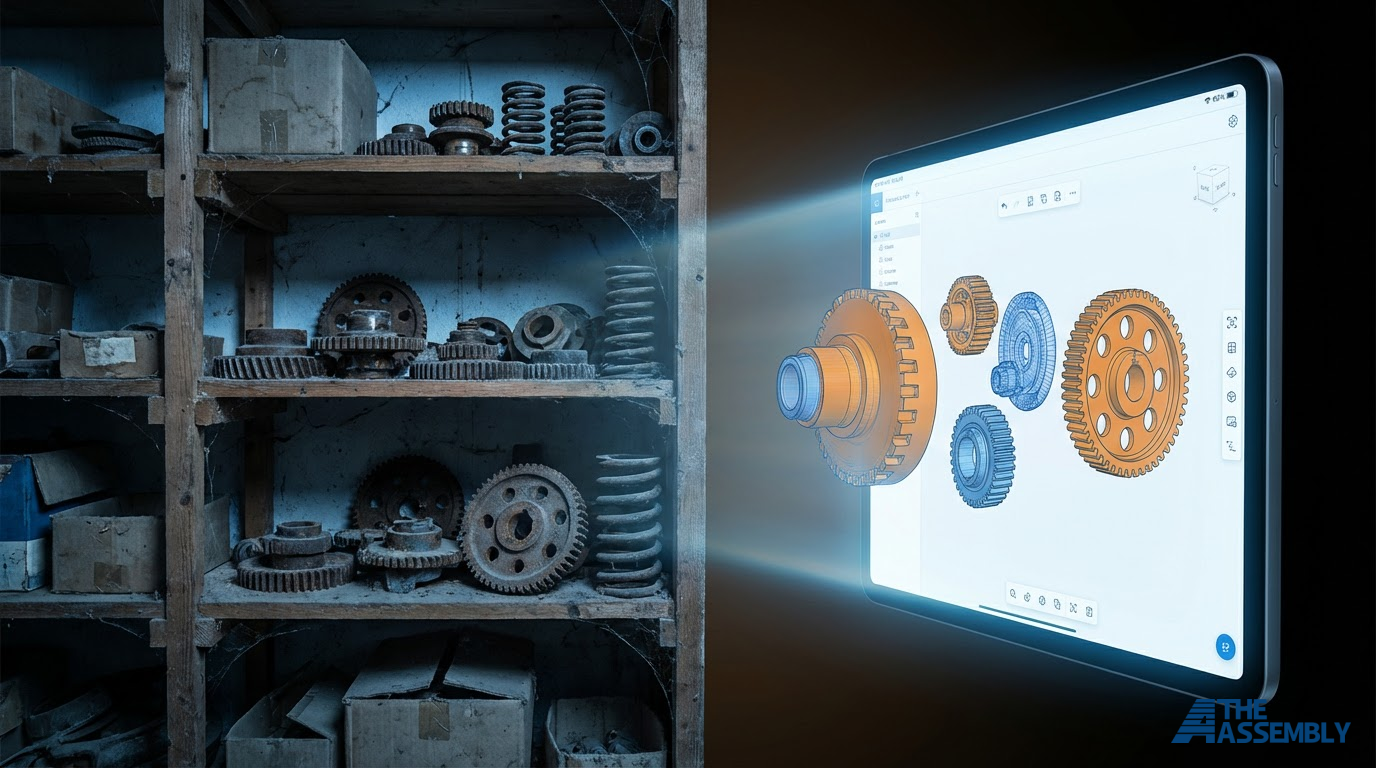
Digital inventory is the practice of storing manufacturing designs as digital files, such as CAD models and 3D scans, and producing physical parts on demand through a network of local manufacturers, instead of warehousing finished goods.
Think of it this way: instead of a shelf full of 500 replacement gaskets, you have a verified digital file for that gasket. When a customer needs one, it gets manufactured and delivered within 2 days through a facility near the delivery address. You store nothing. You carry nothing. You produce exactly what’s needed, when it’s needed.
This is not inventory management software. A lot of people confuse the two. Inventory management software helps you track what’s on your shelves. Digital inventory replaces the shelves.
And it’s not limited to 3D printing, despite what most articles on this topic will tell you. Digital inventory works across any advanced manufacturing method controlled by computer: CNC machining, multi-axis milling, additive manufacturing (FDM, SLS, SLA, MJF), laser cutting, and more. The right production method is selected based on the part’s material requirements, tolerances, volume, and timeline. The digital file is the constant. The manufacturing method is the variable.
You keep the design. We make the part. Only when you need it.
How it differs from traditional inventory
| Factor | Traditional Inventory | Digital Inventory |
|---|---|---|
| What you store | Finished physical parts | CAD files and production specs |
| Storage cost | $15+/sq ft warehouse space | Negligible (secure digital storage, cloud or local) |
| Carrying cost | 20-30% of inventory value annually | Near zero |
| Minimum order | Often 500-10,000 units | 1 unit |
| Lead time | 6-12 weeks from overseas suppliers | As fast as 2 days from local production |
| Obsolescence risk | High (parts become outdated, materials degrade) | None (files don’t expire, and design updates are a quick CAD revision) |
| Capital required | Major (purchase + store + insure) | Minimal (pay per part, on demand) |
| Geographic flexibility | Fixed warehouse locations | Produced near point of need |
Why Digital Inventory Matters Now
Digital inventory isn’t new as a concept. 3D printing companies have talked about “digital warehousing” for a decade. But three forces are converging right now that make it not just viable, but necessary, for Canadian manufacturers.
1. The carrying cost crisis is at its peak
Interest rates have kept borrowing costs elevated since 2022. That means the capital cost component of carrying inventory, which already represented more than half of total carrying costs, has gotten significantly more expensive.
According to APQC (the gold standard for supply chain benchmarking), inventory carrying costs run 20-30% of total inventory value per year. For a company carrying $5 million in parts inventory, that’s $1 million to $1.5 million annually just to keep those parts on shelves.
Break that down:
- Capital costs: The opportunity cost of money tied up in inventory. At current rates, this alone can be 10-15% of inventory value.
- Warehouse space: Canadian industrial rents averaged $15.11/sq ft at end of 2024. New warehouse construction costs range from $77 to $139/sq ft depending on size.
- Insurance and taxes: Typically 2-5% of inventory value.
- Obsolescence and shrinkage: The silent killer. Parts become outdated. Materials degrade. Specifications change. In well-run companies, 20-30% of inventory is dead or obsolete stock that will eventually be written off.
For most manufacturers, carrying costs are invisible. They’re spread across rent, insurance, depreciation, and a dozen other line items. Nobody sees a single “carrying cost” entry on the income statement. Which is exactly why it gets ignored while it compounds.
Digital inventory doesn’t reduce these costs. It eliminates most of them entirely. You can’t have carrying costs on parts you don’t carry.
2. The tariff crisis is reshaping Canadian supply chains
65.5% of Canadian manufacturing businesses reported that US tariffs had a negative impact on their operations in 2025, according to Statistics Canada.
The numbers are stark. A 25% blanket tariff on Canadian goods entering the US. Steel and aluminum tariffs at 50%. Automotive parts at 25%. Canada’s retaliatory tariffs adding another layer of cost on imports.
The Canadian Federation of Independent Business found that nearly 1 in 5 small businesses dealing with tariff costs won’t survive more than 6 months if conditions don’t change. 38% said they’d last less than a year.
This matters for digital inventory because tariffs expose the fragility of stretched supply chains. Every part that crosses an international border is now a cost risk. Every container sitting on a ship is a timeline risk. The Red Sea disruptions added 10-14 days and 4,000 extra miles to Asia-Europe shipping routes. Transit times increased 30% overall.
Digital inventory with local production eliminates cross-border risk entirely. Parts manufactured locally and delivered in as fast as 2 days don’t cross borders. They don’t sit on container ships. They aren’t subject to tariff whiplash.
3. The Buy Canadian movement has government backing
On December 16, 2025, the federal government implemented the Policy on Prioritizing Canadian Suppliers and Canadian Content for strategic federal procurement. Contracts over $25 million must now prioritize Canadian suppliers. By spring 2026, that threshold drops to $5 million.
Nearly $186 million in new funding backs this policy.
This isn’t symbolic. It’s structural. Canadian-manufactured parts now have a procurement advantage that didn’t exist 12 months ago. Digital inventory produced through a Canadian manufacturing network qualifies. Parts imported from overseas do not.
For companies selling to government, defense, or any sector with Canadian content requirements, digital inventory isn’t a nice-to-have. It’s a compliance requirement in disguise.
How Digital Inventory Works
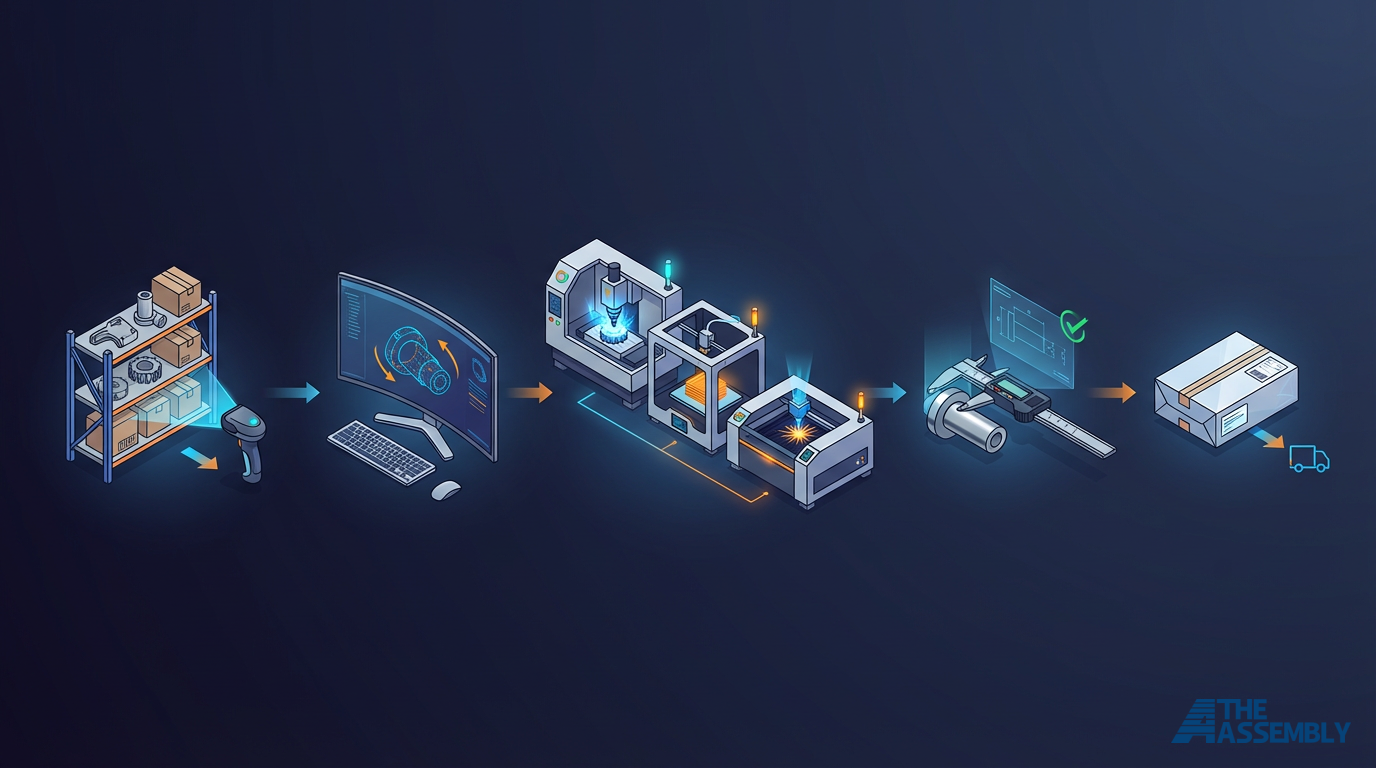
The process has five stages. It’s less complex than most people expect.
Stage 1: Audit your physical inventory
Start with what you’re currently warehousing. Identify every SKU, its annual demand, its current carrying cost, and its manufacturing specifications.
The best framework for this is ABC/XYZ analysis. ABC ranks your parts by value (A = top 20% of parts driving 80% of value, B = middle, C = bottom). XYZ ranks by demand predictability (X = steady demand, Y = variable, Z = sporadic or unpredictable).
Your first digitization candidates are the CZ and BZ parts: moderate-to-low value, unpredictable demand. These are the parts costing the most to store relative to how often they’re actually ordered. They sit on shelves for months. They tie up warehouse space disproportionately. And they’re the easiest to convert because they don’t need the bulk pricing that high-volume A-parts justify.
Most companies find that 60-80% of their SKUs fall into these long-tail categories, accounting for less than 20% of actual demand.
Stage 2: Digitize the parts
Every part needs a verified digital file. There are three paths depending on what you have:
Path A: You already have CAD files. Many manufacturers have original design files in STEP, IGES, or native CAD formats. These need to be validated against the physical part to ensure they match current production specs (designs sometimes drift from what’s actually manufactured).
Path B: You have drawings but no 3D models. Engineering drawings get converted to 3D CAD models. This is standard work for any capable design engineering firm.
Path C: You have nothing but the physical part. This is where reverse engineering comes in. The part gets 3D scanned using industrial-grade scanners (accuracy to 0.05mm or better), and the scan data is converted to a production-ready CAD model. For complex geometries, this might include CMM (coordinate measuring machine) verification for critical dimensions.
The output is a verified, production-ready digital file with full manufacturing specifications: material, tolerances, surface finish, heat treatment, any post-processing requirements.
Stage 3: Select production methods
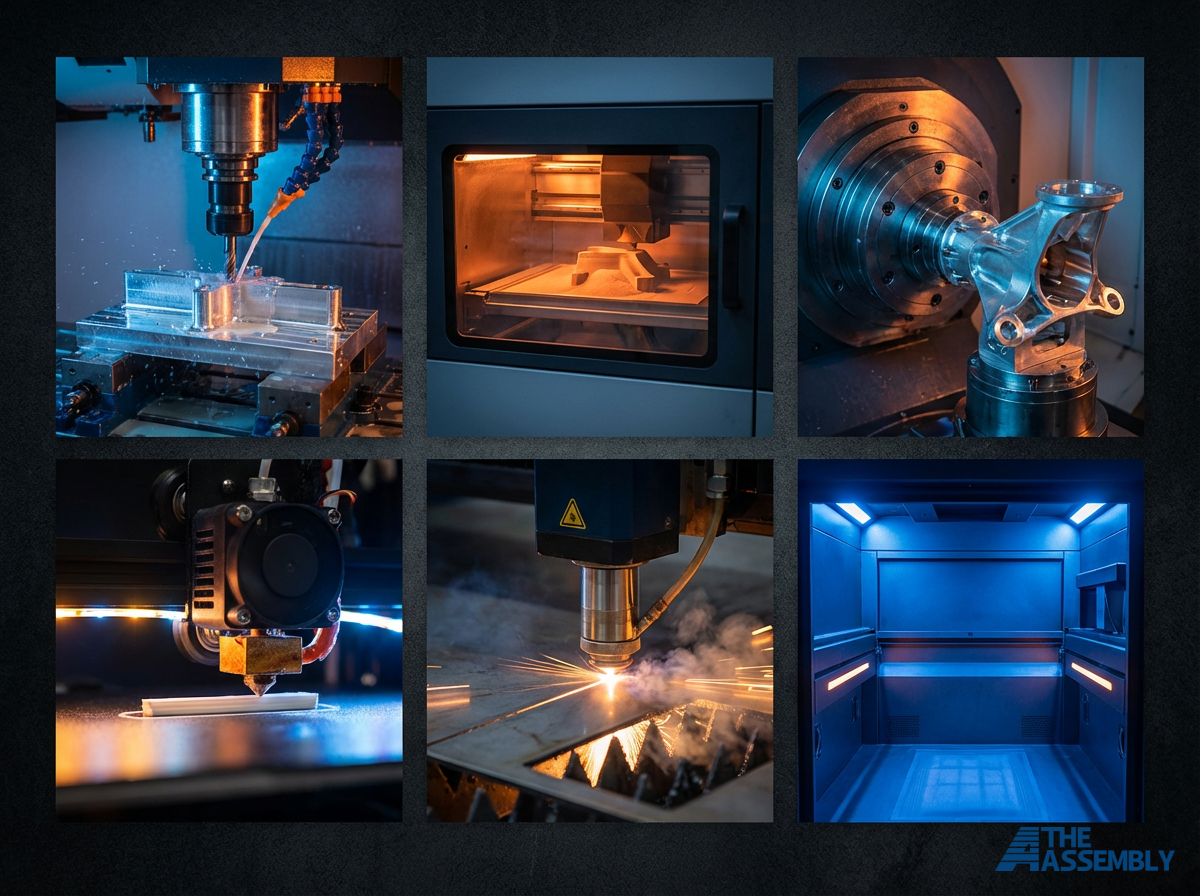
Not every part should be 3D printed. This is where most “digital inventory” articles get it wrong. They assume additive manufacturing is the only production method. It’s one option among several.
The right method depends on the part. What qualifies? Anything controlled by computer, anything that falls under the umbrella of advanced manufacturing:
| Method | Best For | Typical Tolerance |
|---|---|---|
| CNC machining (milling) | Tight tolerances, metal parts, high-stress applications | +/- 0.025mm |
| CNC turning | Cylindrical/rotational parts, shafts, bushings | +/- 0.025mm |
| Multi-axis CNC | Complex geometries requiring 4- or 5-axis capability | +/- 0.025mm |
| FDM 3D printing | Prototypes, jigs, fixtures, low-stress functional parts | +/- 0.5mm |
| SLS 3D printing | Complex geometries, small-to-medium production runs | +/- 0.3mm |
| SLA 3D printing | High-detail parts, smooth surface finish requirements | +/- 0.1mm |
| MJF 3D printing | Production-grade nylon parts, high throughput | +/- 0.3mm |
| Laser cutting | Flat profiles, gaskets, precision-cut components | +/- 0.1mm |
A digital inventory system doesn’t lock you into one method. The production spec for each part defines the optimal method, and the network routes production accordingly. A replacement bracket might be CNC machined from aluminum. A cable management clip might be SLS printed in nylon. A precision housing might require 5-axis milling.
Same digital inventory. Different production paths. Matched to the part, not to the machine.
Stage 4: Validate and qualify
Before a digitized part goes live in your inventory, it needs to pass qualification:
- Dimensional verification: Produced part is measured against the original spec. Critical dimensions must fall within tolerance.
- Material certification: Material traceability documentation confirms the correct material and grade.
- Functional testing: Where applicable, the part is tested in its actual application to confirm fit, form, and function.
- First article inspection: A formal FAI documents every dimension and specification, creating a quality baseline for future production.
This is a one-time effort per part. Once qualified, the digital file and production spec become the master record. Every subsequent order produces from the same validated baseline.
Stage 5: Produce on demand
When a part is needed:
- The order triggers production at the nearest qualified facility in the network.
- The digital file and production spec are transmitted securely.
- The part is manufactured, inspected, and shipped.
- Delivery in as fast as 2 business days for most parts. Complex parts requiring multiple operations may take longer.
No warehouse pull. No shipping from a central distribution center. Production happens close to where the part is needed, using the most appropriate manufacturing method.
The Business Case: Real Numbers

Let’s run the math on a mid-size Canadian manufacturer carrying $3 million in spare parts inventory.
Current state (physical inventory)
| Cost Category | Annual Cost |
|---|---|
| Carrying costs (25% of $3M) | $750,000 |
| Warehouse rent (2,000 sq ft at $15/sq ft) | $30,000 |
| Insurance on inventory | $15,000 |
| Warehouse labor (0.5 FTE) | $30,000 |
| Annual write-offs (obsolescence, 5% of inventory) | $150,000 |
| Total annual cost of holding inventory | $975,000 |
Plus the hidden cost: $3 million in working capital locked on shelves instead of deployed for growth.
Future state (digital inventory)
| Cost Category | Annual Cost |
|---|---|
| Secure digital file storage and management | $2,400 |
| On-demand production (same parts, produced as needed) | Varies by demand |
| Per-part premium vs. bulk (typically 10-30% higher per unit) | Offset by zero carrying cost |
| Total annual fixed cost | $2,400 |
Working capital freed: up to $3 million (depending on demand pattern).
The per-unit cost of on-demand production is higher than bulk manufacturing. That’s true. If you’re ordering 10,000 identical parts, bulk is cheaper per unit.
But that comparison ignores carrying costs. It ignores the 5-10% of parts that become obsolete before they’re ever used. It ignores the insurance, the rent, the labor, and the $3 million in working capital doing nothing.
When you compare total cost of ownership, not just unit price, digital inventory wins for any part with low-to-moderate annual demand and any level of demand unpredictability.
Where the math doesn’t work (and we’ll tell you)
Digital inventory is not a universal replacement. It doesn’t make sense for:
- High-volume commodity parts with stable, predictable demand (bolts, washers, standard fasteners). Buy these in bulk. That’s fine.
- Parts with extreme tolerances that require dedicated tooling and process control beyond what a distributed network offers.
- Time-critical safety stock where even 2 days is too long (medical devices in active patient care, for example). Keep a small physical buffer.
The sweet spot is the 60-80% of SKUs in your inventory that have low, sporadic, or unpredictable demand. The parts that sit on shelves for months. The ones you over-order because the MOQ forces you to buy 500 when you need 12.
Those parts are costing you a fortune to store. And they’re the easiest to digitize.
Who’s Already Doing This
Digital inventory isn’t theoretical. Some of the largest companies in the world have already made the shift.
Deutsche Bahn (German Railway)
Deutsche Bahn has produced over 200,000 replacement and series parts via on-demand manufacturing across 700+ applications since 2015. They currently maintain approximately 1,000 virtual models in their digital warehouse, with a target of 10,000 components by 2030.
The results: up to 60% cost reduction versus conventional manufacturing procurement. Lead times dropped from 10 months (conventional spare part procurement) to 2 months.
For a railway operator maintaining fleets of trains across decades, this solves a fundamental problem. Original equipment manufacturers stop making parts. Tooling gets scrapped. Parts become “unobtainable.” Digital inventory makes them permanently available. And when a part design needs to evolve, whether for material upgrades, compatibility with newer systems, or regulatory changes, the update is a CAD revision, not a retooling project. (Source: Deutsche Bahn)
Daimler Trucks (Mercedes-Benz)
Daimler identified approximately 40,000 bus and touring coach spare parts suitable for digital inventory across the Mercedes-Benz and Setra brands. Parts are produced on demand at or near the point of need, eliminating the requirement for physical tooling and inventory storage for those components.
Volvo Construction Equipment
Volvo CE now 3D prints and delivers spare parts in as little as one week, with no minimum order quantity. This is particularly valuable for older equipment where traditional manufacturing is no longer cost-effective or even possible.
What the research shows
A 2024 study published in ScienceDirect modeled virtual warehousing through digitalized inventory and on-demand manufacturing. The findings:
- Up to 99% inventory cost reduction compared to traditional warehousing
- 17% immediate CO2 emissions savings (projected to 65% by 2030 as manufacturing energy grids decarbonize)
- 65% fewer backlog orders under supply chain disruption scenarios compared to centralized systems
Those are modeled numbers, not guarantees. But the directional evidence is clear: digital inventory reduces costs, reduces emissions, and improves resilience.
Digital Inventory and IP Security

One of the first questions operations leaders ask: “If my designs are digital files moving through a network, how do I protect them?”
It’s the right question. And it’s the reason most “upload your file to our marketplace” platforms are fundamentally unsuited for digital inventory.
When you upload a part file to a global manufacturing marketplace, you lose control over who sees it, where it’s manufactured, and what jurisdiction your intellectual property passes through. For any company with proprietary designs, defense contracts, or competitive manufacturing processes, this is a non-starter.
A proper digital inventory system needs three layers of protection:
1. Design isolation
Digital files are encrypted at rest and in transit. Access is role-based. The machinist producing your part sees only the manufacturing data required for that production run, not your full design library. No file is ever stored on the production facility’s systems after the run is complete.
2. Production isolation
Each production facility in the network sees only its own jobs. Facility A doesn’t know what Facility B is producing. The network operator manages routing and quality. Individual producers handle manufacturing. No single point in the chain has visibility into the full production picture.
3. Jurisdictional control
For Canadian companies, this means your designs never leave Canadian soil. They’re stored on Canadian servers, transmitted to Canadian manufacturers, and produced in Canadian facilities. This isn’t just a nice policy. For defense-adjacent and government work, it’s a requirement.
In a digital inventory model, IP security should actually improve compared to traditional supply chains. Today, your designs might be sitting on a supplier’s server in Shenzhen, backed up to a cloud service you’ve never audited, accessible to employees you’ve never vetted. A properly architected digital inventory system puts you back in control.
Digital Inventory for Canadian Manufacturers: The Specific Advantage

Everything above applies globally. But Canadian manufacturers have a structural advantage that makes digital inventory particularly powerful right now.
The sovereignty factor
Canadian-owned, Canadian-operated manufacturing networks can handle work that foreign-owned platforms cannot. Controlled Goods Program (CGP) registration. Defense procurement requirements. Government “Buy Canadian” compliance. These aren’t abstract differentiators. They’re contract requirements.
Xometry is American-owned. Protolabs is American-owned. Wurth is German-owned. For any work touching Canadian defense, sensitive government procurement, or CGP-controlled goods, foreign ownership is a structural disqualifier.
A Canadian digital inventory network operating through Canadian facilities doesn’t have this problem.
The proximity factor
Canada is big. Shipping a part from a central warehouse in Ontario to a customer in Nova Scotia takes time and costs money. A distributed manufacturing network with facilities across the country produces parts close to where they’re needed.
For Atlantic Canada, where The Assembly is headquartered, the nearest major manufacturing hub for most traditional supply chains is 1,500+ km away in southern Ontario or Quebec. A distributed network with local production capability in the Maritimes means 2-day delivery instead of 7-14 days.
The reshoring factor
40% of US companies are predicted to relocate part of their supply chains to North America by 2026, according to Deloitte. Canada is a nearshoring destination for US companies wanting CUSMA compliance. At the same time, Canadian companies are looking to reduce US dependency.
Digital inventory through a Canadian network serves both directions. US companies get CUSMA-compliant Canadian production. Canadian companies get domestic supply chain independence.
The tariff-proofing factor
Parts produced domestically don’t cross borders. They aren’t subject to tariffs. They aren’t delayed by customs. They don’t require CUSMA rules-of-origin documentation.
In a trade environment where 65.5% of Canadian manufacturers report negative tariff impacts, removing cross-border dependency from your supply chain isn’t a strategic nice-to-have. It’s risk management.
How to Get Started
Converting from physical inventory to digital isn’t an overnight project. But it doesn’t have to be overwhelming either. The approach that works is progressive, not wholesale.
Step 1: Pick your first 5 parts
You don’t need to boil the ocean. Start with 5 parts. Pull your inventory data. Sort by carrying cost per unit (not just total inventory value). Find the parts that are expensive to store relative to how often they’re actually ordered.
Look for:
- Parts with fewer than 12 orders per year
- Parts with MOQs that forced you to buy far more than you need
- Parts for equipment that’s aging out (original suppliers may stop manufacturing)
- Parts with simple to moderate geometry (good candidates for CNC or 3D printing)
Five parts is enough to prove the concept without any meaningful risk. And once you see the first 5 work, the next 50 become obvious.
Step 2: Get a manufacturability assessment
Not every part is a candidate for on-demand production. A manufacturing partner should be able to review your candidate list and tell you:
- Which parts can be produced on demand with current technology
- Which manufacturing method is optimal for each part
- What the per-unit cost looks like compared to your current procurement
- Where you’ll need to adjust material specs or tolerances
This assessment should be free or low-cost. If someone wants to charge you $50,000 for a “digital transformation study” before you’ve digitized a single part, you’re talking to a consultant, not a manufacturer.
Step 3: Digitize and validate a pilot batch
Take your top 10-20 candidates. Digitize them (CAD files, production specs, quality requirements). Produce a first article for each. Validate against your existing parts.
This pilot proves the concept with real parts from your actual inventory. You’ll learn which parts translate perfectly, which need spec adjustments, and which aren’t good candidates at all.
Step 4: Scale progressively
Once the pilot validates, expand. Add 50 more parts. Then 100. Each batch gets easier because the process is established and the quality baseline is proven.
Most companies can digitize their entire long-tail inventory (the 60-80% of SKUs with low demand) within 6-12 months. High-volume parts stay in traditional procurement. Low-volume parts move to digital. The physical warehouse shrinks. Working capital gets freed. Carrying costs drop.
The Future of Inventory Is Digital
The $5.97 billion global on-demand manufacturing market is projected to reach $24.79 billion by 2034, growing at 15.3% annually. Canada’s additive manufacturing sector alone is expected to grow from $243.7 million to $1.06 billion by 2030.
These aren’t projections about a distant future. The companies mentioned in this guide, Deutsche Bahn, Daimler, Volvo, are operating digital inventories today. The technology exists. The networks exist. The business case is proven.
What’s changing is urgency. Tariff volatility. Interest rate pressure on carrying costs. Government procurement mandates for Canadian content. Labor shortages that make warehouse operations harder to staff. Every one of these forces makes digital inventory more compelling than it was 12 months ago.
The question isn’t whether digital inventory will become standard practice. The question is whether you’ll be an early adopter who captures the working capital advantage or a late follower who adopts it after your competitors already have.
Physical inventory made sense when manufacturing was centralized, lead times were fixed, and global trade was predictable. That world is over.
Your warehouse, digitized. That’s the next era of manufacturing.
FAQ
What types of parts can be stored as digital inventory?
Any part that can be defined by a digital file (CAD model, 3D scan, engineering drawing) and manufactured through advanced, computer-controlled methods like CNC machining, 3D printing (FDM, SLS, SLA, MJF), or laser cutting is a candidate. The best candidates are low-to-moderate demand parts with simple to complex geometry. Extremely high-volume commodity parts (standard fasteners, for example) are typically still more cost-effective to bulk purchase.
Is digital inventory only for 3D printed parts?
No. This is a common misconception. Digital inventory works across all major advanced manufacturing methods: CNC machining (milling, turning, multi-axis), laser cutting, and multiple 3D printing technologies (FDM, SLS, SLA, MJF). The key requirement is that the method is computer-controlled, meaning it can produce directly from a digital file. The manufacturing method is selected based on the part’s requirements, not the other way around.
How much does it cost to digitize a part?
Costs vary based on complexity. If you already have CAD files, the cost is minimal (file validation and production spec creation). If parts need to be reverse engineered from physical samples via 3D scanning, expect $200-$1,000 per part depending on complexity. This is a one-time cost per part. Once digitized, the file is permanent.
How fast can digital inventory parts be produced?
As fast as 2 business days for most parts through a distributed manufacturing network. That’s the Amazon standard applied to manufacturing. Complex parts requiring multiple operations or post-processing may take longer, but the majority of on-demand parts can be produced and delivered within that window.
Is on-demand production more expensive per unit than bulk manufacturing?
Yes, the per-unit cost is typically 10-30% higher than bulk production. But this comparison is misleading without factoring in carrying costs (20-30% of inventory value annually), obsolescence write-offs, warehouse overhead, and the working capital locked in physical inventory. Total cost of ownership is usually lower with digital inventory for any part with annual demand under a few hundred units.
How is intellectual property protected in a digital inventory system?
A properly designed system uses encrypted file storage, role-based access controls, and production isolation (manufacturers only see the data needed for their specific production run). For Canadian operations, files should never leave Canadian servers or Canadian manufacturing facilities. This provides stronger IP protection than traditional supply chains where designs may reside on overseas suppliers’ systems.
Can digital inventory work for regulated industries (aerospace, defense, medical)?
Yes, but with additional requirements. Aerospace parts typically need AS9100-certified production. Defense parts may require Controlled Goods Program (CGP) compliance. Medical devices have their own regulatory framework. Digital inventory systems serving these sectors need qualified facilities and documented quality management systems that meet the relevant standards.
What happens if the on-demand manufacturer can’t produce my part?
A distributed manufacturing network has multiple facilities with overlapping capabilities. If one facility is at capacity or down for maintenance, production routes to the next qualified facility. This redundancy is a structural advantage over single-source traditional supply chains.
How does digital inventory affect my existing ERP or inventory management system?
Digital inventory integrates with existing systems. Your ERP still tracks what you have and what’s been ordered. The difference is that “what you have” shifts from physical stock levels to digital file availability. Most ERP systems can accommodate this with minor configuration changes, not a full replacement.
How do I calculate whether digital inventory makes sense for my business?
Start with your current total carrying cost (inventory value x 25% is a reasonable starting estimate). Add your annual obsolescence write-offs, warehouse rent attributed to parts storage, and insurance. That’s your baseline cost of physical inventory. Compare it against the per-unit premium of on-demand production multiplied by your actual annual demand. For most companies, the math favors digital inventory for 50-80% of SKUs.
Ready to see what digital inventory could save your business?
Two ways to start:
Run the numbers first. Use our Digital Inventory Savings Calculator to estimate your current carrying costs and see what shifting to on-demand production would look like for your inventory profile.
Talk to someone who’s done this. Book a 15-minute call with our team. Tell us what you’re warehousing, and we’ll tell you which parts are candidates, what the production cost looks like, and whether the math works for your operation. No pitch. Just answers.