Why a Manufacturing Network Beats a Manufacturing Marketplace
Xometry will get you a quote in 30 seconds. That’s genuinely impressive.
But a quote isn’t a supply chain. A quote is a number on a screen. It doesn’t tell you who’s making your part, whether they’ll make it the same way next time, or what happens when your border crossing gets held up for three days.
Canadian manufacturers keep comparing platforms on quoting speed. That’s the wrong comparison. The real question is: what happens after the quote?
The Marketplace Model
Xometry, Protolabs Network, and platforms like them are marketplaces. They work like Uber for manufacturing. Upload a file, get a price, get a part.
The model is optimized for transactions. Every order is independent. The algorithm finds the cheapest available shop, routes the job, and moves on. You don’t pick the shop. You don’t build a relationship with them. Next order, different shop.
For a one-off prototype in Detroit, this works. You need 10 aluminum brackets by Friday, you don’t care who makes them.
But manufacturing isn’t ride-sharing. A bad Uber ride wastes 20 minutes. A bad production run wastes thousands of dollars, weeks of lead time, and your customer relationship.
The Network Model
A network is fundamentally different from a marketplace.
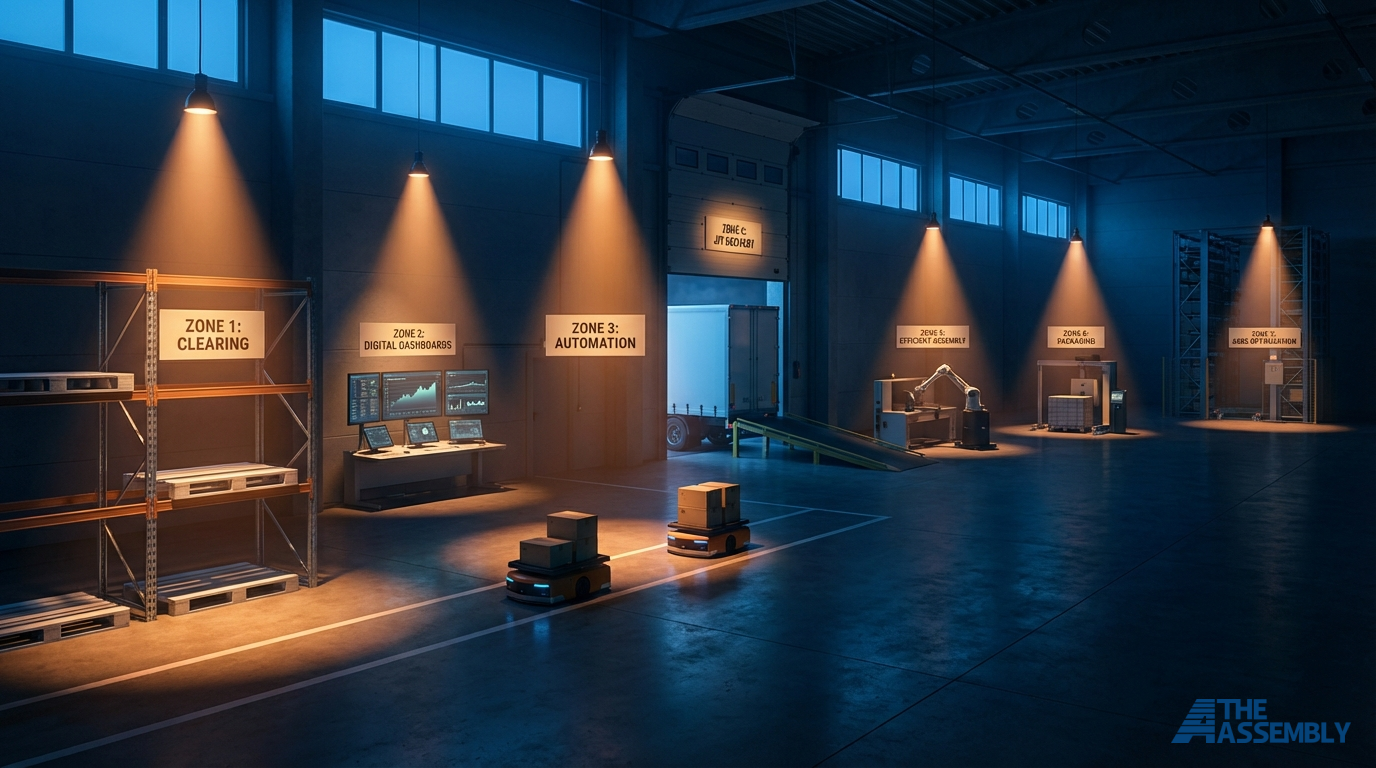
Instead of 10,000 anonymous suppliers competing on price, a network is a curated group of production partners operating under shared standards. The operator vets every shop, manages quality across the group, and routes work based on capability and production history, not just who’s cheapest.
When you reorder, the same shop makes your part. They remember your tolerances. They know which features are critical. They’ve built institutional knowledge about your production. That compounds over time.
This is what The Assembly built. A vetted network of Canadian manufacturers. Every shop evaluated, onboarded, and quality-verified. Repeat orders go to the same facility. Production stays local.
Why This Matters More Than Quoting Speed
Consistency. A marketplace gives you a different shop every time. Quality varies. Finishing varies. The part that was perfect last month comes back slightly different this month because a new shop got the job. A network gives you the same shop, the same operators, the same institutional knowledge.
Relationships. You can’t build a supply chain on anonymous transactions. When you need to rush an order, adjust a tolerance mid-run, or solve a material problem, you need a shop that knows you. Marketplaces don’t do relationships. Networks are built on them.
IP protection. When you upload a CAD file to a marketplace, it gets distributed to whoever wins the bid. You don’t know who downloads your file. You don’t know how they store it after production. For commodity parts, fine. For proprietary designs, that’s a structural risk. A network with controlled file access solves this at the architecture level.
Resilience. Supply chains break. Borders close. Tariffs change overnight. When your parts are made by anonymous shops scattered globally, you have no fallback. When your parts are made by a network of vetted Canadian shops within 200km, you have options.
The Canadian Problem with US Marketplaces
This isn’t theoretical. Canadian companies using Xometry pay a 16% premium on every order. Tariffs, customs brokerage, currency exchange. That’s before you factor in border delays, IP routed through US servers, and disqualification from defence contracts that require Canadian production.
Xometry is a $500M revenue company. Good platform. Built for American buyers. The minute you put a Canadian shipping address into a US marketplace, the economics change.
The Assembly is Canadian. Production happens in Canada. Transactions are in CAD. Files stay on Canadian infrastructure. If you do any work touching defence or controlled goods, this distinction isn’t a preference. It’s a compliance requirement.
When a Marketplace Makes Sense
We’ll be honest. Marketplaces have their place.
If you need a one-off prototype in an exotic material that no Canadian shop stocks, a global marketplace gives you access to capacity you can’t find locally. If you’re testing five different processes and need instant budget estimates, algorithmic quoting is a useful screening tool.
The marketplace wins on breadth and speed for transactional, low-stakes orders.
When a Network Wins
The network wins everywhere else.
Recurring production. Parts with tight quality windows. Anything with IP sensitivity. Defence and government work. Orders where consistency matters more than getting a quote 30 seconds faster.
The more complex, sensitive, or ongoing your manufacturing needs, the more the network model outperforms the marketplace. The value compounds. Every reorder is faster. Every quality conversation builds on the last one. Your supply chain gets stronger over time instead of resetting to zero with every transaction.
What This Looks Like in Practice
We maintain a trusted network of vetted Canadian manufacturers across CNC machining, 3D printing, laser cutting, sheet metal, welding, and finishing processes. When you work with The Assembly, you’re not uploading a file into an algorithm. You’re getting matched to the right shop for your specific project.
If you need a warm introduction to a manufacturer, we make it. If you need to split a job across two shops because one handles the machining and another handles the finishing, we coordinate that. If a shop can’t take a job, we route it to another vetted partner, not a random bidder.
That’s not something a marketplace can do.
Book a call to talk about your manufacturing needs. We’ll tell you honestly whether a marketplace or a network is the right fit for your situation.
Frequently Asked Questions
Is The Assembly more expensive than Xometry?
On a per-unit basis, sometimes yes, sometimes no. On total landed cost for Canadian buyers, we’re almost always less. Factor in tariffs, customs brokerage, currency exchange, shipping delays, and the cost of quality inconsistency, and the 16% cross-border premium that US marketplaces carry for Canadian buyers disappears.
Can I use both a marketplace and a network?
Yes. Some teams use a marketplace for ballpark pricing on unfamiliar processes and a network for actual production. That said, The Assembly handles prototypes and quick-turn jobs too. The difference is that even your prototype orders build toward a long-term production relationship instead of disappearing into a black box.
What processes does The Assembly’s network cover?
CNC machining, 3D printing (FDM, SLA, SLS, MJF, DMLS), laser cutting, sheet metal, welding, injection molding, casting, and finishing (anodizing, powder coating, plating, heat treatment, and more). If your project needs a process we don’t have in-network, we’ll tell you.
How do you vet your manufacturing partners?
Every shop is evaluated on capability, equipment, quality systems, certifications, and capacity. We run test jobs before onboarding. We monitor quality on production orders. Shops that don’t meet standards don’t stay in the network.
What about quoting speed?
We won’t quote you in 30 seconds. Our quotes are engineer-reviewed for accuracy, which takes minutes to hours depending on complexity. The trade-off is that you get a quote you can trust, not an algorithmic estimate that changes when you actually place the order.